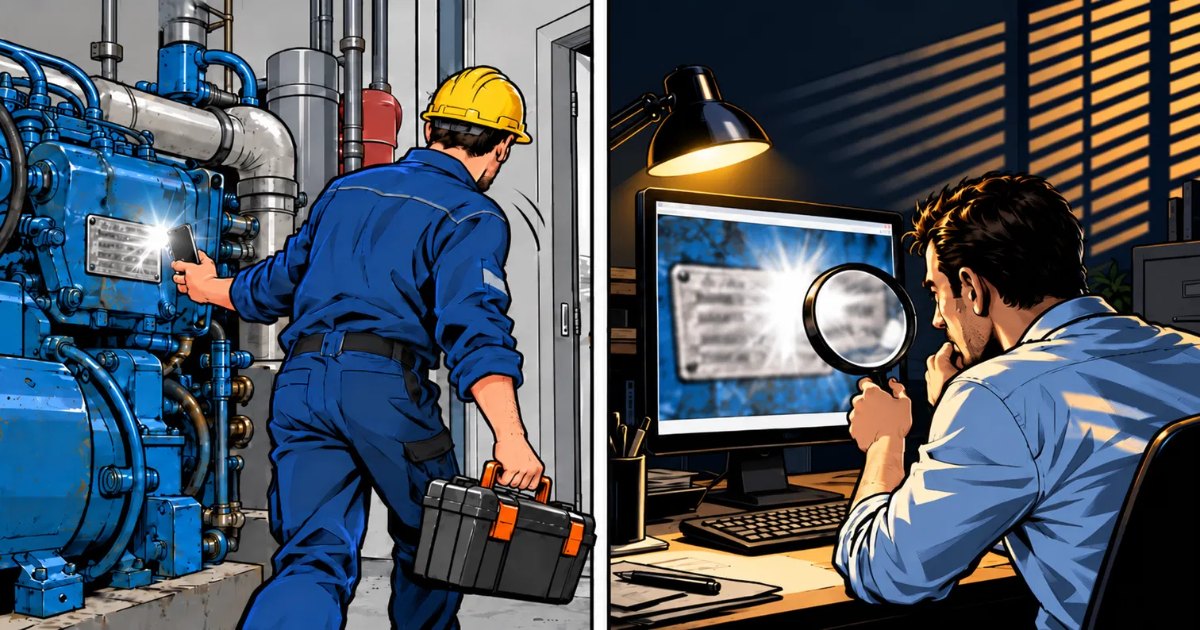
Anyone who has watched an engineer wedged into a boiler cupboard, thumbing a fourteen-character serial number into a phone, understands why image recognition sits high on the wish list of so many service companies. One photo of the nameplate, and the details land on the job sheet. That promise holds more often than the sceptics expect, and less often than the vendors would have it.
The camera reads along
Extracting text from photos has been around for decades under the name OCR, and for most of that time it did exactly what the name suggests: it recognised characters without understanding what they meant. In recent years a new layer has arrived on top. Language models that can read images now see which number on a nameplate is the serial, which is the rated output and which is the year of manufacture, and they put each one in the right field.
Job sheet software now offers this as a standard feature: the engineer takes a photo of a nameplate or document inside the form, and the details are read out and placed in the right fields [1]. In practice the process has three steps: the photo, the reading and sorting, and the engineer's check before anything reaches the job sheet. That last step looks like a formality. It is where everything is decided.
FIG. 01From photo to job sheet in three steps, with the engineer's check as the step that makes the difference.
Where it already works
Under favourable conditions the technology has matured. A clean nameplate with printed lettering, photographed straight on, a digital display with crisp figures or a barcode sticker rarely causes trouble. One supplier of extraction software quotes accuracy of up to 99 per cent for a sharp photo of a digital meter display [2]. That is a sales claim, and better read as a ceiling than an average, but field trials point the same way: a European project on nameplates in chemical plants halved the time needed to identify an asset with its prototype [3].
For an installation company with twenty engineers servicing hundreds of boilers every autumn, the gain is tangible. Each service visit yields make, model, serial number and year without any typing, and the asset register grows a little more reliable with every visit.
Where it goes wrong
The real test comes in the plant room. It is dark, the plate is half hidden behind a pipe, twenty years of grease and dust have worn the engraving thin, and the phone's flash bounces straight off the serial number. A recent study of reading analogue water meters from smartphone photos, taken in varying light, from varying angles and on dirty meters, arrived at an average of 91 per cent correct readings, with the biggest drop in strong glare and on faulty meters [4]. That sounds respectable until it is turned around. One photo in eleven comes back wrong.
Meters with needles are a separate problem altogether. A needle position contains no characters, so conventional text recognition has quite literally nothing to read [5]. Engraved plates set an obvious trap of their own: after years of wear, a zero and the letter O, or a 1 and an I, become almost indistinguishable.
FIG. 02A weathered nameplate from a marine engine, read by a language model. Ten of the eleven fields come through correctly; for the eleventh it remains unclear whether the character is a zero or the letter O.
What matters more than the number of errors is the form they take. An engineer who cannot read a figure will say so. A language model rarely does. Research presented at NeurIPS 2025 shows that, faced with blurred, partly obscured or low-contrast images, these models fall back on what they expect to see, offering a likely answer where an honest "illegible" was called for [6]. A 2026 test using increasingly faint strings of digits confirms the picture: the latest models transcribe clearly visible figures almost flawlessly, then fall apart as the digits fade [7].
The result is a serial number that looks entirely credible, save for one character. An empty field gets noticed. A plausible wrong digit travels quietly onward into the parts order, the warranty claim and the asset register.
FIG. 03Where an engineer would write "illegible", the system fills in a character that looks every bit as real as the rest.
The steady improvement of these models changes less than many assume. A 2026 comparison of eighteen models found that larger models and more reasoning steps raise scores on clean images without reliably reducing the errors caused by blur or poor lighting [8].
Faulty parts: only as good as the catalogue
Recognising a loose, faulty component is a different matter, because there is often no text on it at all. Bosch shows what is possible: with ProScan an engineer photographs a part, receives suggestions for matching replacements and orders them straight from the Buderus web shop [9]. Behind that simplicity lies a good deal of preparation, as every part is photographed automatically from all sides, 300 to 500 images apiece, to train the system [9].
That also marks the limit. Recognition is exactly as good as the catalogue behind it, and for a mixed estate with pumps from six manufacturers and a controller from 2003, no such catalogue exists.
What it means for technical service
On the job sheet itself, the time saved is more modest than often assumed. Typing in a serial number takes perhaps half a minute, as a rough estimate. The costly mistake comes later, when the wrong part is ordered on the strength of one wrong character and the engineer has to make a second visit. The real gain therefore lies in the quality of the asset register. A company that uses every service visit to record make, model and serial number with a photo will, after one season, have a register that work preparation and planning can rely on: the planner knows in advance which boiler is on the wall, the right parts go in the van and the warranty team no longer has to hunt for a year of manufacture.
For the back office, the photo itself may be the most underrated part. Keeping the original image with the job sheet means every extracted value can later be checked against the plate, and any dispute with a customer or manufacturer has the evidence close at hand.
Situation
RELIABILITY
WHAT IT TAKES
Clean, printed nameplate
High
A straight-on photo and a quick check of the serial number
Digital display or barcode
High
A sharp photo without glare
Dirty, engraved or weathered plate
Variable
A second photo from another angle, every field checked
Analogue meter with needles
Low to variable
Specialist software or a manual reading
Faulty part without markings
Only within one manufacturer's catalogue
The manufacturer's catalogue, otherwise a manual search
Reading nameplates and digital meter displays is useful, provided the result is treated as a draft. Part recognition works within one manufacturer's catalogue and is worth watching beyond it.
We apply one rule that separates a useful tool from a silent source of errors: the engineer confirms every extracted field, and the photo stays with the job sheet as evidence. A system that enforces this speeds up the work. A system that passes the data on unseen simply moves the error to a point where it costs more.
VERDICTAPPLICABLE NOW
Nameplates, barcodes and digital displays can be read reliably on site, provided the engineer confirms the result and the photo stays linked to the job sheet. Dirty, engraved or poorly lit plates and analogue meters still need a human eye, and part recognition only works within a single manufacturer's catalogue.
How Robust is OCR-Reasoning? Evaluating OCR-Reasoning Robustness of Vision-Language Models under Visual Perturbations (OCR-Robust), June 2026.hyper.ai/de/papers/2606.26041