Noise or relevant: AI news for technical service companies
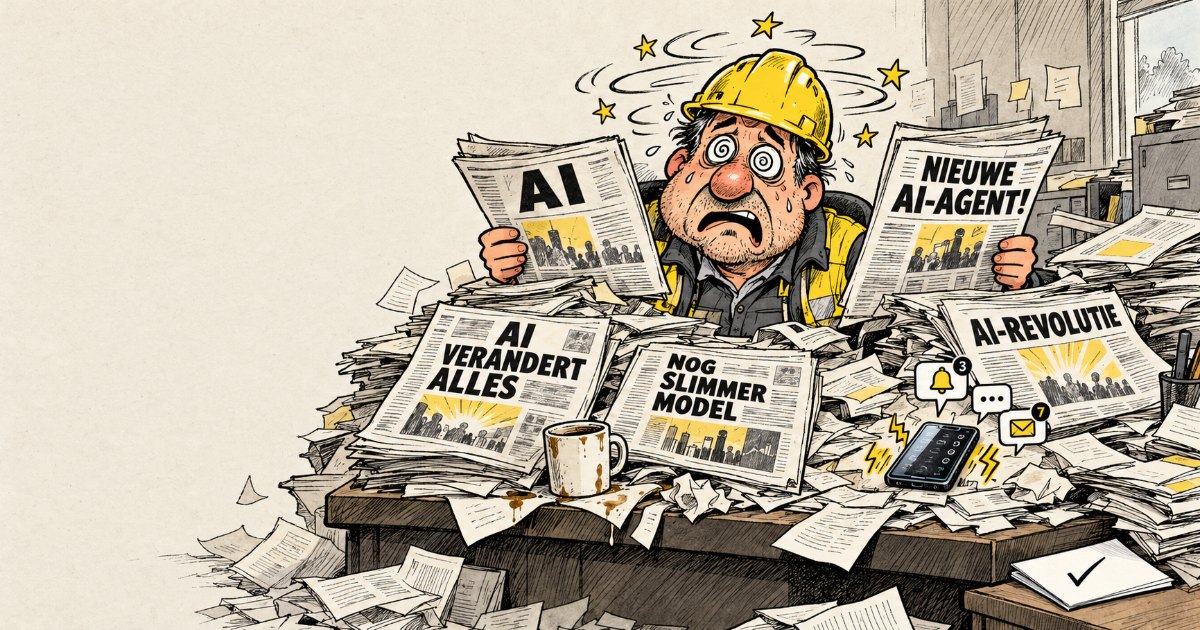
Every week brings dozens of AI announcements, nearly all of them promising that everything is about to change. For an installation or maintenance company, remarkably little usually does. Four questions are enough to tell which announcement actually matters for scheduling, the job sheet or the invoice.
A news stream written for someone else
Most AI news revolves around software companies, marketing and office work, and tends to look at the American market first. That is no accident: the news follows the money and the users, and for now those sit mostly outside the technical trades. Statistics Netherlands (CBS) reported at the end of 2025 that one in six Dutch companies uses AI, twice as many as two years earlier, with use highest in information and communication and lowest in sectors including construction. Companies that do use AI mainly put it to work in marketing and sales.
Anyone in technical services who follows AI is therefore mostly reading news written for a different audience, and has to pick out the few items that genuinely matter to their own sector.
How hype is made
On top of that, many announcements sound bigger than they are, and the word doing most of the heavy lifting at the moment is "agent". Research firm Gartner has a name for it, "agent washing": existing chatbots and automation get a fresh label because "agent" sells better. By Gartner's 2025 estimate, only about 130 of the thousands of vendors offering so-called agents deliver anything genuinely new.
Pilots are no different. Researchers at MIT looked at hundreds of corporate AI projects in 2025 and found that the vast majority never made it past the trial stage. In a press release, a successful trial with one customer quickly becomes a breakthrough. On the shop floor, it remains a trial with one customer.
In 2025, Gartner placed generative AI in the phase where early expectations get revised, as users run into problems and returns that disappoint. For a service company, that is good news rather than bad: this is the phase in which inflated offerings fall away and whatever remains becomes easier to judge.
Where AI does land in a service company
An engineer's work is physical, and no language model is going to open up a boiler. In its market outlook of August 2026, the Dutch installation sector association Techniek Nederland wrote that AI in the sector mainly improves administrative processes, while the installation work itself remains labour-intensive.
That is precisely where the opportunity lies. The same MIT research found that most of the money went to sales and marketing, while the biggest returns came from the back office. In a service company, that means the work surrounding the job: the engineer who spends another quarter of an hour typing in the van afterwards, the planner who has to reshuffle three rosters for an emergency callout, the accounts team checking job sheets before an invoice can go out. That work rarely makes the headlines.
Four questions for every announcement
An announcement that matters to technical services passes four questions. FIG. 01 shows how that plays out in practice: a great deal goes in, and very little comes out.
Is it available here? Many announcements apply first to the United States and to English-speaking users; Apple initially kept its AI features out of the EU in 2024, citing European regulation. For a service company, two further questions follow: does it work in Dutch, including trade terms and the way an engineer describes a fault, and where are customer addresses and fault data processed? On top of that, the European AI rules are being phased in, and some already apply, such as the obligation to give staff who work with AI sufficient knowledge of it.
Does it work with the field service software? Most service companies already run their work through a system for scheduling, job sheets and invoicing. An AI tool that sits outside it means entering everything twice, or copying and pasting, and a planner will put up with that for a few weeks at most. So the question is whether an integration exists, whether the software vendor builds the feature in itself, and whether the tool can read what is already on the job sheet.
Is it affordable for twenty engineers? AI software is usually billed per user per month. For the sake of a calculation built on assumptions of our own, let us assume a tool costs 30 euros per user per month and that twenty engineers and five office staff need a licence. That comes to 750 euros a month, or 9,000 euros a year. If each engineer saves half an hour of admin a week, that adds up to 460 hours a year over 46 working weeks. Whether that justifies the spend depends on what those hours are worth and whether they are genuinely freed up. An announcement with no price, only a button to request a demo, rules out that calculation from the start.
Which bottleneck does it solve, and for whom? A useful announcement makes clear which task disappears or gets shorter, and for whom: the planner, the engineer or the accounts team. If that is still unclear after reading, the announcement is not relevant for now.
One announcement through the sieve
Take a made-up but familiar example: a press release about an AI agent that plans the entire maintenance process autonomously, from an American start-up with an impressive demo and a sizeable funding round behind it.
Held up against the four questions, little of it survives. The software is only available in English and the data is stored in the United States; there are integrations with a handful of American CRM systems and with no Dutch field service software at all, and the price is on request. What "autonomous planning" actually means is never explained either: does it account for certifications, for emergency callouts, for an engineer who calls in sick?
Against that stands an announcement hardly anyone shares: a few lines in the release notes of a Dutch field service software vendor. From the next version, engineers can dictate a job sheet in the app, the text lands in the right fields, and the feature costs a fixed amount per user per month. TABLE 01 puts the two side by side: the first makes the trade press, the second passes all four questions. For a service company, the dullest news is often the most useful.
TABLE 01The press release about an autonomous planning agent and the release note about dictating job sheets, checked against the four questions.
What is useful, and when
What is already within reach is the processing of text and speech within existing work: dictating a job sheet, summarising a fault report, searching a manual. CBS saw the use of speech recognition by companies triple between 2023 and 2025, while text analysis grew from 4 to 12 percent. The technology is mature enough. The real test is how it fits in, and that calls for Dutch, an integration with the field service software and a price known in advance.
Worth watching are the agents that plan, order or deal with customers on their own. The promise is big and the idea is sound at its core; practice simply has not caught up yet. Gartner expects more than 40 percent of projects involving such agents to be cancelled by the end of 2027, because of cost, unclear value or insufficient control over the risks. We will take them seriously once they turn up in Dutch field service software, with a customer who has been using them for six months.
Noise is anything that promises "everything will change" without saying which task disappears, and that includes savings percentages without a baseline. "Forty percent less admin time" looks impressive, yet says little as long as nobody knows how much time it took before, and for whom.
Where the useful news is
What is actually becoming available can be read in the release notes and customer days of a company's own field service software vendor. For the wider picture, CBS publishes annual figures on AI use by companies, broken down by sector, the Dutch Data Protection Authority (Autoriteit Persoonsgegevens) publishes a report twice a year on the risks of AI and algorithms in the Netherlands, and Techniek Nederland is researching what AI and robotics mean for the installation sector in its CONNECT2030 programme.
The best source is still a fellow company, because what another installation company has been using every day for six months says more than any press release. For this sector, keeping up with AI mostly means leaving a great deal of noise unread. That is perfectly fine.
The four questions cost nothing and require no technical knowledge. They work for every news item, every demo and every quote, and they force vendors to be specific about availability, integration with the field service software and price.
- CBS (December 2025). Bedrijven gebruiken AI vaakst voor marketing of verkoop. www.cbs.nl/nl-nl/nieuws/2025/50/bedrijven-gebruiken-ai-vaakst-voor-marketing-of-verkoop
- ANP via Nieuws.nl (12 December 2025). CBS: flink meer bedrijven gebruiken AI. nieuws.nl/economie/cbs-flink-meer-bedrijven-gebruiken-ai
- Solar Magazine (3 August 2026). Personeel grootste knelpunt voor groei installatiebranche (on Techniek Nederland's market outlook). solarmagazine.nl/nieuws-zonne-energie/i44407/personeel-grootste-knelpunt-voor-groei-installatiebranche
- Fortune (18 August 2025). MIT report: 95% of generative AI pilots at companies are failing. fortune.com/2025/08/18/mit-report-95-percent-generative-ai-pilots-at-companies-failing-cfo
- NOS (June 2024). Siri toch nog niet slimmer: Apple stelt AI-functies in EU uit. nos.nl/l/2525638
- Stibbe (March 2026). The Dutch AI & Algorithms Report: a call to action (on the AI literacy requirement in force since 2 February 2025). www.stibbe.com/publications-and-insights/the-dutch-ai-algorithms-report-a-call-to-action
- Gartner (25 June 2025). Gartner Predicts Over 40% of Agentic AI Projects Will Be Canceled by End of 2027. www.gartner.com/en/newsroom/press-releases/2025-06-25-gartner-predicts-over-40-percent-of-agentic-ai-projects-will-be-canceled-by-end-of-2027
- Gartner (14 July 2025). Hype Cycle for Generative AI, 2025. www.gartner.com/en/documents/6719134
- Accountant.nl (March 2026). AP: kabinet moet haast maken met regelgeving rondom AI (on the twice-yearly Dutch AI & Algorithms Risk Report). www.accountant.nl/nieuws/2026/3/ap-kabinet-moet-haast-maken-met-regelgeving-rondom-ai/
- Solar Magazine (13 April 2026). AI en robotisering: wat zijn de consequenties voor installateurs? (on Techniek Nederland's CONNECT2030 programme). solarmagazine.nl/nieuws-zonne-energie/i43471/ai-en-robotisering-wat-zijn-de-consequenties-voor-installateurs
Want to discuss this topic?
A short message or just an email address is enough. You will get a reply within two working days.